Next.js 16 Full-Stack Mastery: React 19 & App Router
Master modern Next.js 16 and React 19 by building production-ready web applications using the App Router, Server Actions, and advanced TypeScript patterns. Designed for developers looking to transition from legacy concepts to high-performance, full-stack architectures.
25 lessons · about 10 hours · by Chukwuma Ebube · 0 forks
Fork this outline into your library and start learning.
Start this courseLesson preview
First look
Next.js 16 & React 19 Setup
# Next.js 16 & React 19 Setup 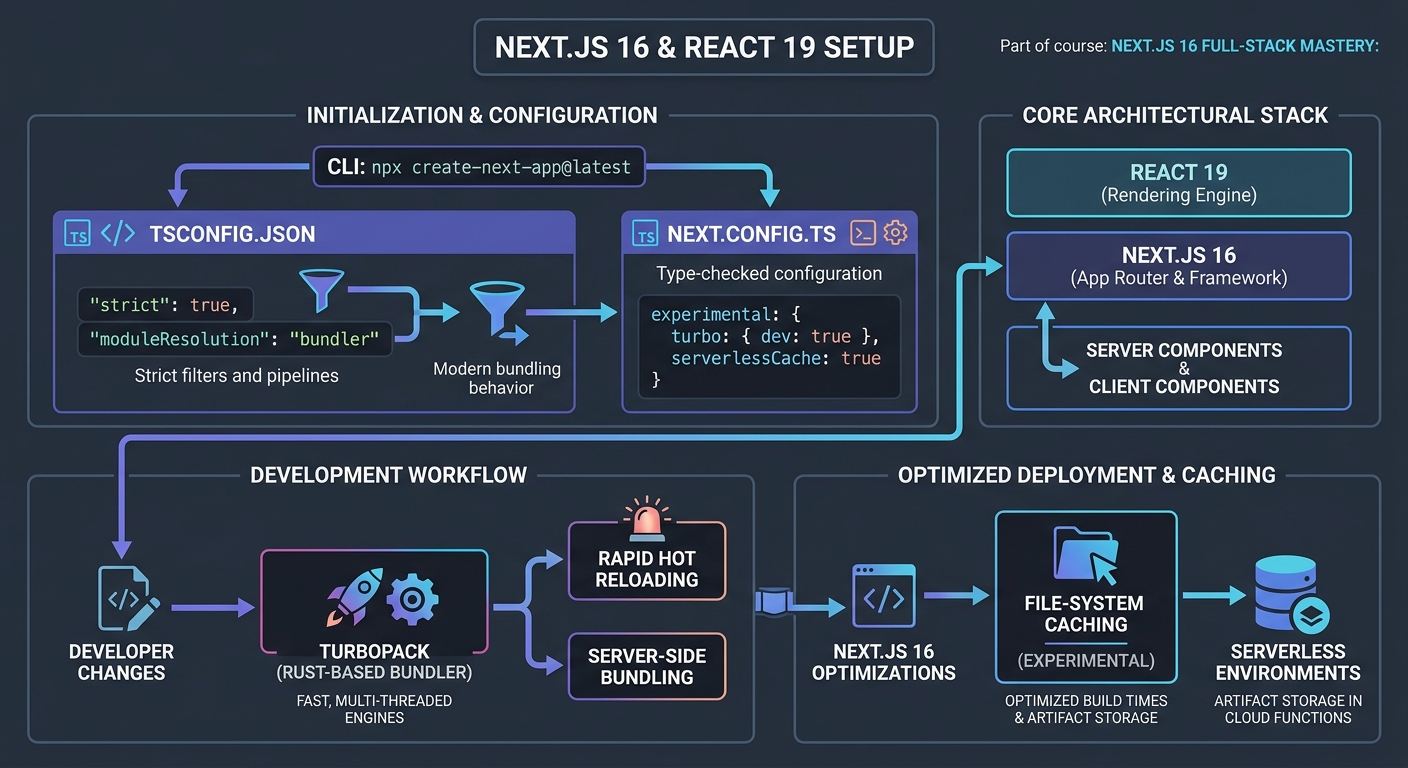…
Syllabus
25 lessons across chaptersModule 1: Modern App Router Architecture & Async Request Context
6 lessonsLesson 1
Next.js 16 & React 19 Setup
Configure Next.js 16 projects with TypeScript, Turbopack, and strict build configurations.
Lesson 2
App Router Hierarchy & Colocation
Analyze the modern App Router file-system hierarchy, special files, and colocation patterns.
Lesson 3
Async Request Parameters & Context
Implement async request APIs to safely access route `params` and `searchParams`.
Lesson 4
Dynamic Runtime APIs & Boundaries
Isolate dynamic runtime APIs like `cookies()` and `headers()` to prevent accidental route-wide degradation.
Lesson 5
Layouts, Templates, & Error Boundaries
Configure root and nested layouts with parallel data loading patterns and error boundaries.
Lesson 6
Parallel & Intercepting Routes
Implement parallel routes and intercepting routes for advanced modal and dashboard workflows.
Module 2: Cache Components & The `use cache` Paradigm
5 lessonsLesson 7
The Cache Components Paradigm
Transition from implicit caching models to the unified Cache Components model in Next.js 16.
Lesson 8
Implementing the `'use cache'` Directive
Apply the `'use cache'` directive to asynchronous functions and granular UI components.
Lesson 9
Cache Lifecycles & Revalidation Tags
Configure explicit cache expiration profiles using `cacheLife` and granular invalidation tags with `cacheTag`.
Lesson 10
Isolating Request State from Cached Scopes
Isolate request-specific state from cached scopes to avoid shared-state corruption.
Lesson 11
Programmatic Cache Invalidation
Handle cache purge workflows and programmatic revalidation in server actions.
Module 3: Partial Prerendering (PPR) & Streaming Architecture
4 lessonsLesson 12
Partial Prerendering Architecture
Architect high-performance hybrid applications combining static shells with dynamic data streams.
Lesson 13
Suspense Boundaries & Streaming UI
Implement React `<Suspense>` boundaries to stream granular dynamic content chunks.
Lesson 14
Loading States & Fallback UX
Optimize loading states and fallback UI components for zero layout shifts.
Lesson 15
Route Segment Config & PPR Tuning
Configure dynamic segment caching and route segment config options for PPR.
Module 4: Server Actions & React 19 State Mutations
6 lessonsLesson 16
React 19 Actions & Mutation Fundamentals
Analyze React 19 action primitives and seamless client-to-server data mutations.
Lesson 17
Form State Management with `useActionState`
Construct resilient forms using `useActionState` for pending states and error handling.
Lesson 18
Form Status Tracking with `useFormStatus`
Track submission lifecycle events using `useFormStatus` inside nested client components.
Lesson 19
Optimistic Updates with `useOptimistic`
Implement optimistic UI updates with `useOptimistic` for instant feedback during mutations.
Lesson 20
Server-Side Payload Validation & Zod
Validate server action payloads securely using Zod schemas and type guards.
Lesson 21
Authentication & Session Cookies in Actions
Manage secure HTTP-only cookies and session tokens inside server actions.
Module 5: Production Optimization, Security, & Edge Deployment
4 lessonsLesson 22
React Compiler Integration
Leverage the React Compiler to eliminate manual memoization (`useMemo`, `useCallback`).
Lesson 23
Security Headers & Edge Middleware
Configure Content Security Policy (CSP), headers, and secure middleware routing.
Lesson 24
Asset Optimization & Core Web Vitals
Configure bundle analyzer, image optimization, and font loaders for peak web vitals.
Lesson 25
Production Deployment & Edge Routing
Deploy production-ready Next.js 16 applications to Vercel and serverless edge environments.
Forking copies the syllabus and lesson text into your private library.